
Discover how AI is changing SEO, website traffic and affiliate marketing, and learn practical ways to keep your website visible in the age of AI.
What happens when people no longer need to visit your website to find the answers they are looking for?
For years, website owners have been encouraged to research keywords, create helpful articles and work towards those coveted positions on Google’s first page. But artificial intelligence is changing the relationship between being found and actually receiving a visitor.
Imagine spending an afternoon researching and writing a detailed guide, only for a search engine to summarise its main points before anyone reaches your website. Your content might contribute to an answer, yet the reader may never see your photographs, your recommendations or the resources you have spent time creating.
As someone running three websites at very different stages of development, I find this a particularly important question. I am not ready to abandon SEO, but I am increasingly conscious of how vulnerable an online business can be when it relies too heavily on one way of attracting visitors.
In this guide, I look at how AI is changing SEO, what that means for affiliate marketing, and the practical steps independent website owners can take without chasing every new optimisation trend.
From Search Engines to Answer Engines
Traditional search is familiar. You enter a question, scan a selection of results and decide which website deserves your attention. You might open several pages, compare their advice and gradually form your own opinion. With conversational AI, much of that initial research can take place within a single interface.
For example, instead of searching separately for the best WordPress hosting, the cost of starting a blog and the skills needed for affiliate marketing, a beginner might ask an AI assistant to build a complete starting plan within a particular budget. They can then refine the answer without beginning a new search.
| Traditional search | AI-powered search |
|---|---|
| Ranked links and snippets | Synthesised answers with possible source links |
| Separate keyword searches | Conversational questions and follow-ups |
| Reader compares websites | Assistant can summarise and compare sources |
| Rankings, impressions and clicks | Citations, mentions, rankings and referrals |
| Research often takes place on websites | Some research happens before a website visit |
These approaches overlap. Google still displays conventional results, and AI assistants can send people to websites for deeper research. The change is not that websites suddenly have no role, but that they may be encountered at a different point in the decision-making process.
Google AI Overviews – Visibility Without the Click
Google’s AI Overviews provide generated summaries within search results. AI Mode offers a more conversational research experience, particularly for questions involving several considerations. Both can present links to supporting websites.
The challenge for publishers is that a useful summary may satisfy the reader without a click. A July 2025 Pew Research Center study examined browsing activity from 900 US adults during March 2025.
| Observed behaviour | With AI summary | Without AI summary |
|---|---|---|
| Clicked a traditional result | 8% | 15% |
| Clicked a summary source | 1% | Not applicable |
| Ended browsing session | 26% | 16% |
These figures describe that particular sample and period, not a universal forecast for every website. The queries triggering summaries may also differ from those that do not. Nevertheless, the findings illustrate why publishers should monitor clicks separately from visibility.
Google itself argues that generative search opens new discovery opportunities. Its June 2026 website-owner announcement also describes new controls and performance insights. Increased usage of AI search does not, however, tell an individual publisher whether their own revenue will increase.
My advice: Do not assume that a healthy impression count automatically means your website is attracting a healthy number of visitors. Look at the relationship between impressions, clicks and actual business outcomes.
ChatGPT and Other AI Search Platforms
Google is not the only place where this shift is happening. ChatGPT Search, Perplexity, Microsoft Copilot and Google Gemini offer different ways to gather information and ask follow-up questions. Their source selection, availability and presentation vary, and their answers can contain mistakes.
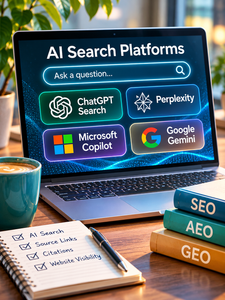 A reader might ask for a comparison of two ice cream makers, request a beginner’s guide to building a website or seek a list of emergency supplies. Instead of opening ten browser tabs, they can narrow the question through conversation. A source link may offer the next step when the reader wants more detail.
It is worth separating three concepts: a model learning from training material, a search system retrieving information for a current question, and an answer explicitly citing a website. Being included in training is not the same as being cited, and a citation is not the same as a visit. No website owner can guarantee all three.
For publishers, this also raises a question of control. OpenAI distinguishes its search crawler from its training crawler in its crawler documentation. We will return to that distinction when considering website settings.
SEO, AEO and GEO – What Do They Mean?
New terminology can make a familiar subject seem unnecessarily complicated. These three terms describe related objectives, rather than three completely separate disciplines.
| Term | Meaning | Objective |
|---|---|---|
| SEO | Search Engine Optimisation | Visibility in search results |
| AEO | Answer Engine Optimisation | Content useful for direct answers |
| GEO | Generative Engine Optimisation | Potential visibility in generated responses |
A well-written guide can serve all three objectives. Consider an article explaining how to set up a WordPress affiliate website. A descriptive heading helps someone navigate the guide, a clear explanation answers a question, and original screenshots provide evidence that the author understands the process.
AEO and GEO are evolving industry labels, not certifications or guaranteed ranking techniques. I would be wary of paying for a service simply because it promises to make a website appear in AI answers. Ask what the service actually does, how it measures results and whether the work is useful to your readers anyway.
What AI Search Means for Affiliate Marketing
Affiliate marketing depends on connecting a reader with a suitable product or service. Traditionally, that has involved attracting a visitor, earning their trust and giving them a reason to follow a recommendation. AI can intervene at several stages of that journey.
A reader might obtain a shortlist of products before arriving at a review. That could reduce the number of preliminary visits, but a detailed comparison could still help someone who is ready to buy. For websites supported by display advertising, fewer page views may have a different financial effect from fewer highly targeted affiliate referrals.
| Content type | Potential challenge | Practical response |
|---|---|---|
| Basic informational posts | A short summary may suffice | Add examples and useful context |
| Product reviews | Specifications can be summarised | Show actual experience and limitations |
| Comparisons | AI can assemble a shortlist | Explain testing criteria and trade-offs |
| Tutorials | Basic steps can be reproduced | Include screenshots and troubleshooting |
| Case studies | Claims may be summarised | Publish original evidence and context |
| Resources and tools | Generic descriptions may suffice | Offer useful downloads or functionality |
These are possible outcomes, not predictions of how every niche will perform. A review that merely repeats a manufacturer’s specifications is particularly difficult to distinguish from other sources. A review explaining what surprised you, what failed and who should avoid the product has a more distinctive purpose.
Do not invent personal testing to make a review appear more authoritative. If you are comparing published specifications rather than products you own, say so. Transparency is especially important when a recommendation can earn you a commission.
Is Traditional SEO Becoming Obsolete?
No, traditional SEO is not obsolete. Google’s guidance on generative AI search explains that conventional search foundations still matter.
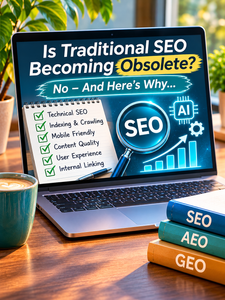 Its newer guidance also rejects the need for special AI markup, artificial content chunking or an llms.txt file specifically for Google Search.
There is a practical reason for maintaining those foundations. If a page cannot be accessed or indexed, improving its wording alone will not resolve that underlying problem. Likewise, a website that is difficult to use on a phone may disappoint the reader who does arrive through an AI citation.
The right response is not to discard your existing SEO work. Review whether it is helping the intended reader and whether the website is functioning properly. If traffic falls, investigate before changing everything at once. My guide to adapting to Google’s algorithm updates explains how to approach that investigation.
How to Make Your Website More AI-Friendly
1. Create something original
Think about the questions you can answer from experience. A photograph of a completed project, an account of a mistake or a comparison based on actual use adds a dimension that a generic summary cannot supply. Start with your strongest articles rather than trying to rewrite your whole site.
2. Answer questions clearly
Give the reader the answer where it makes sense, then explain the qualifications and practical details. Do not hide a simple answer halfway down a long introduction. Equally, avoid reducing complicated subjects to misleading one-line conclusions.
3. Structure content for people
Use descriptive headings, readable paragraphs, accessible tables and relevant internal links. A long guide should be easy to navigate on a mobile screen. There is no need to restructure every paragraph according to a supposed AI formula.
4. Build connected subject coverage
If you publish a beginner’s guide, link to genuinely helpful supporting articles. A website about affiliate marketing might connect website setup, keyword research, content creation and monetisation. Avoid publishing dozens of near-identical pages simply to target variations of a question.
5. Show credibility and evidence
Explain who wrote the article, distinguish facts from opinions and link to authoritative sources where appropriate. Update outdated claims and be explicit about affiliate relationships. Originality does not excuse inaccuracy; readers need both.
6. Maintain technical accessibility
Review indexing, broken links, mobile usability and server availability. Ensure key information is available as readable text rather than only inside an image. Keep structured data consistent with visible content and do not add markup purely in the hope of gaining an AI citation.
7. Understand crawler permissions
Before altering robots.txt or a CDN firewall, establish which crawler you are affecting. OpenAI identifies OAI-SearchBot as its search crawler and GPTBot as a crawler associated with model training; their controls are independent. Google has also announced separate generative-search controls in Search Console. Check availability and current documentation for your own property rather than assuming that every platform uses identical rules.
8. Give readers a reason to visit
Consider what a short generated answer cannot provide: a printable checklist, detailed photographs, a working calculator, an original recipe, or a guide that can be followed alongside a practical task. Choose additions that serve your audience rather than creating extras merely to increase page length.
Remember: Search and training permissions have different purposes. Make deliberate choices about access to your content, and keep a record of any technical changes so you can reverse them if necessary.
Measuring Website Performance in the AI Era
The temptation is to judge success by whether an AI assistant mentions your domain. That can be interesting, but it is not a complete measure of website performance. Responses can differ by query, location and time, so a handful of manual searches cannot establish reliable overall visibility.
Google’s current guidance describes a Generative AI performance report in Search Console. Check whether it is available for your property, and use it alongside conventional search reports. OpenAI’s publisher guidance also explains that ChatGPT search referral links include a source tracking parameter. Analytics can help identify those visits, although not every AI-related discovery journey will be attributable.
| Metric | What to investigate |
|---|---|
| Search impressions | Are relevant pages being shown? |
| Organic clicks and CTR | Is visibility producing visits? |
| AI search reporting | What visibility is reported where available? |
| AI referral sessions | Which identifiable visits reach the site? |
| Engagement and conversions | Do visitors find what they need and take action? |
| Email sign-ups | Are you building a direct audience? |
| Revenue by channel | Which sources contribute to sustainable income? |
Compare equivalent periods and account for seasonal demand, changes in publishing and technical problems. A small increase in AI referrals may be worth watching, but it should not automatically justify diverting resources away from an established traffic source. The objective is to understand what is working commercially and editorially.
My Experience – Adapting as a Website Owner
I am approaching these changes from three different perspectives because my websites are at different stages of development.
Frosted Fusions – Learning from an established website
In July 2025, Frosted Fusions experienced a dramatic decline in organic search traffic. Since then, I have invested considerable time in reviewing the website, improving its technical foundations and developing alternative traffic sources. Pinterest has become especially important, and I have also introduced my own short-form videos and an email newsletter. I cannot establish that AI caused the original decline, and I would not make that claim. What the experience has taught me is how important it is to avoid relying on one source of visitors.
Make Xtra Money Online – Revisiting existing content
With this website, I am working through older articles and assessing whether their advice still reflects the platforms and techniques I use today. Sometimes that means a substantial rewrite; sometimes a clearer introduction, updated information and better internal links are enough. I would rather improve an article for a genuine reason than rewrite it solely because a new SEO acronym has appeared.
Preppers Be Ready – Starting with a different perspective
My newest website, Preppers Be Ready, gives me the opportunity to bring these lessons into a project from the beginning. Preparedness is a subject where practical experience matters, and I have my own projects to draw upon, including a reclaimed-material wood store and water collection. My aim is to develop a useful collection of interconnected guides that readers can actually put into practice.
Managing three websites at different stages of development gives me an interesting perspective on how online businesses need to adapt.
I’m learning from an established website, revitalising an existing one and applying those lessons to a brand-new project.
What connects all three is my belief that creating genuinely useful content, demonstrating real experience and building multiple routes through which people can discover our websites are becoming increasingly important in the age of AI.
Beyond Google – Building a More Resilient Business
A more resilient business is one that can continue reaching people when an individual platform changes.
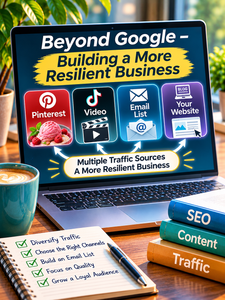 Pinterest can send visitors to visual guides, video can demonstrate a technique and email can help readers return directly to your website. Choose channels that suit your subject and the time you can realistically commit.
Diversification does not mean opening an account on every social platform. Each channel has its own demands, and maintaining several poorly can be less useful than developing one or two properly. Start with a realistic publishing routine, measure meaningful visits and build relationships with the readers who already value your work.
An email list is particularly worth considering because it creates a permission-based route back to your audience. It still requires consent, useful messages and responsible management. The point is not to escape every platform dependency, but to reduce the risk of one change undermining your entire business.
Your AI Search Readiness Checklist
- ☐ Review your highest-priority articles for accuracy and originality.
- ☐ Identify pages that offer little beyond commonly available information.
- ☐ Add firsthand evidence where you genuinely have it.
- ☐ Check indexing and crawler access before changing settings.
- ☐ Improve navigation and relevant internal links.
- ☐ Compare impressions, clicks and conversions separately.
- ☐ Check AI reporting and identifiable referrals where available.
- ☐ Develop a suitable alternative traffic source.
- ☐ Build or strengthen a permission-based email list.
- ☐ Review the evidence before making another major change.
Start with the first few tasks that address a real weakness on your website. You do not need to complete the entire checklist in one afternoon. Keep a simple record of what you changed, why you changed it and what happened afterwards.
Frequently Asked Questions About AI and SEO
Is AI going to replace traditional SEO?
AI is changing search behaviour, but conventional SEO remains relevant. Accessible, useful and indexable content continues to be important for discovery.
Will AI search reduce website traffic?
It may reduce clicks for some queries, particularly when a direct answer satisfies the reader. Other queries may lead to further research. Monitor your own traffic rather than assuming the same outcome for every website.
How can I get my website referenced by ChatGPT?
Publish useful, accurate content and check that OAI-SearchBot is not blocked if you want your content to be eligible for search summaries. Inclusion and citations are not guaranteed.
What is the difference between SEO, AEO and GEO?
SEO focuses on search visibility, AEO on direct answers and GEO on visibility in generative responses. The approaches overlap and none guarantees rankings or citations.
Is affiliate marketing still worth pursuing in the age of AI?
It can be a viable business model, but costs, competition, traffic and conversions vary. Distinctive content and diversified discovery channels may help reduce reliance on any single platform.
Does Google penalise AI-generated content?
Using AI is not in itself the issue. Content created primarily to manipulate rankings, including scaled low-value content, can violate spam policies. Review accuracy, usefulness and originality before publishing.
Should I allow AI crawlers to access my website?
That depends on your objectives and the crawler’s purpose. Search discovery and model training may have separate controls. Review official documentation before changing your settings.
How can small websites compete in AI-powered search?
Focus on subjects you understand, provide original evidence and maintain a clear, accessible website. Build recognition and measure actual outcomes; there is no guaranteed method of securing AI citations.
Related Reading
If you are working towards a more resilient affiliate website, these guides will help you put the principles discussed here into practice:
- How to Adapt to Google’s Algorithm Updates (Without Losing Traffic) – Investigate changes in organic traffic and identify sensible next steps.
- Affiliate Marketing Takes Longer Than Most Beginners Expect – Recognise meaningful progress and develop realistic expectations.
- Learn How to Monetise Your Blog and Generate Extra Income – Consider practical ways to diversify website revenue.
Final Thoughts – Adapt, Don’t Panic
When I started building websites, much of the advice centred on achieving those all-important Google rankings. That advice still has value, but I no longer look at search visibility quite as simply as I once did. Being found is only one part of the journey. We also need to give people a reason to visit, to trust what they find and to return.
 I understand why these changes can feel unsettling, especially when you have put years of work into a website. There is a considerable difference between reading about changing search behaviour and seeing a decline in your own analytics. It makes you question where to invest your time and whether the strategy you have been following still makes sense.
I am not going to stop creating websites because AI can answer questions. I am going to continue reviewing the usefulness of my content, sharing what I have learnt, and building other ways of reaching readers. Not every experiment will work, and I expect my approach to continue evolving.
My advice is to avoid making decisions based on fear or promises of a shortcut. Start with the information available to you. Look at your own data, identify the most important weaknesses, and make improvements you can justify. A website that serves a genuine purpose is worth maintaining even when the routes people take to reach it change.
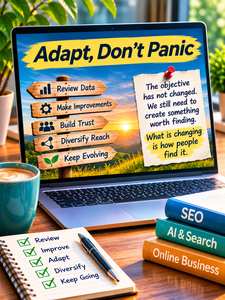
The objective has not changed. We still need to create something worth finding. What is changing is how people find it.
Have you noticed a change in the way visitors reach your website? Are AI search tools becoming part of your own research routine? I would love to hear your experience in the comments below.
Disclosure: Some links on this website may be affiliate links. If you make a qualifying purchase through one of these links, I may earn a commission. I aim to recommend products and services honestly and transparently. Thank you for your support.
